Thursday, 22 December 2016


Monday, 10 November 2014
The constancy of change and the new catastrophism: a personal reflection on crisis-driven science.
In 2010, we published what is now a best-selling (and award-winning) book Canada Rocks-The Geologic Journey aimed at telling the dramatic story for a public audience of how Canada (and North America) has evolved over the last 4 billion years. It was a milestone in our professional and personal lives as we went on many field trips to fill in gaps in our own understanding and in the process stepped well beyond our own areas of expertise. We learned much about this fantastic country and its geology.
What is patently obvious from reviewing Canada’s ancient history is that scientists still do not have an adequate understanding of Earth’s complex systems on which to base sound economic and environmental policy. From the upper reaches of the atmosphere to the depths of the oceans onwards to the deep interior of the planet our knowledge of complex earth systems is still rather rudimentary. Huge areas of our planet are inaccessible and are little known scientifically. There is still also much to learn from reading the rock record of how our planet functioned in the past.
In so many areas, we simply don’t know enough of how our planet functions.
And yet……
Scarcely a day goes past without some group declaring the next global environmental crisis; we seemingly stagger from one widely proclaimed crisis to another each one (so we are told) with the potential to severely curtail or extinguish civilization as we know it. It’s an all too familiar story often told by scientists who cross over into advocacy and often with the scarcely-hidden sub-text that they are the only ones with the messianic foresight to see the problem and create a solution. Much of our science is what we would call ‘crisis-driven’ where funding, politics and the media are all intertwined and inseparable generating a corrupting and highly corrosive influence on the scientific method and its students. If it doesn’t bleed it doesn’t lead is the new yardstick with which to measure the overall significance of research.
Charles Darwin ushered in a new era of thinking where change was expected and necessary. Our species as are all others, is the product of ongoing environmental change and adaption to varying conditions; the constancy of change. In the last 15 years or so however, we have seemingly reverted to a pre-Darwinian mode of a fixed ‘immutable Earth’ where any change beyond some sort of ‘norm’ is seen in some quarters as unnatural, threatening and due to our activities, usually with the proviso of needing ‘to act now to save the planet.’ Honest scientific discourse and debate is often rendered impossible in the face of the ‘new catastrophism.’
Trained as geologists in the knowledge of Earth’s immensely long and complex history we appreciate that environmental change is normal. For example, rivers and coastlines are not static. Those coasts, in particular, that consist of sandy strand-plains and barrier-lagoon systems are continually evolving as sand is moved by the waves and tides. Cyclonic storms (hurricanes), a normal component of the weather in many parts of the world, are particularly likely to cause severe erosion. When recent events such as Hurricanes Katrina and Sandy cause catastrophic damage, and spring storms cause massive flooding in Calgary or down the Mississippi valley, and droughts and wildfires affect large areas of the American SW these events are blamed on a supposed increase in the severity of extreme weather events brought about by climate change. In fact, they just reflect the working of statistical probability and long term climate cyclicity. Such events have happened in the past as part of ongoing changes in climate but affected fewer people. That the costs of weather and climate-related damage today are far greater is not because of an increased frequency of severe weather but the result of humans insisting on congregating and living in places that, while attractive, such as floodplains, mountain sides and beautiful coastlines, are especially vulnerable to natural disasters. Promises of a more ‘stable future’ if we can only prevent climate change are hopelessly misguided and raise unnatural expectations by being willfully ignorant of the natural workings of the planet. Climate change is the major issue for which more geological input dealing with the history of past climates would contribute to a deeper understanding of the nature of change and what we might expect in the future. The past climate record suggests in fact that for much of the Earth’s surface future cooling is the norm. Without natural climate change Canada would be buried under ice 3 km thick; that is it normal state for most of the last 2.5 million years with 100,000 years-long ice ages alternating with brief, short-lived interglacials such as the present which is close to its end.
It is self-evident to us that the public debate concerning environmental change largely lacks an understanding of natural variability. Since the last Ice Age ended, some 12,000 years ago, Earth has been through several periods lasting hundreds of years and possibly longer when it was either warmer or colder than at present. Several earth scientists have suggested that a study of natural variability over recent geologic time should be completed in order to provide a baseline against which anthropogenic change may be evaluated, but this important history has not been introduced fully into the public debate, and is a long way off. It has to be said that the natural variability of the last few thousand years or hundreds of years or tens of years has formed almost no part in the ongoing discussion of climate change which in some circles assumes that any change since 1940 is largely man-made. This opinion is uninformed by geologic science.
The way forward it strikes us is for more scientific honesty and less politics, less grandstanding. ‘We don’t know’ is an honourable credo for scientists. In this regard, we need more science to be directed to the environment, particularly toward better planning of the world’s communities to make them more resilient in the face of change. And it is an increasingly urban face that our planet presents. The many large supercities of the rapidly-approaching future world will be absolutely massive consumers of resources and producers of wastes; they will be the biggest determinants of our global environmental footprint; and it is surely there that much of our effort should be spent. Today, the rate of change of some parts of the world, especially in regard to urbanization and the ‘rush to the city’ is taxing our abilities simply to map and assess the environmental repercussions of transforming a natural environment to a built landscape. There is no simple technological fix either. Satellite and other monitoring data for example still has to be collected, interpreted, ground truthed, and acted on; steps available only to wealthier countries. In large areas of the planet the lack of human and financial resources, equality and personal freedoms and political choices trump any global environmental concerns and hobble international co-operation. To these people our obsession with saving the environment must ring hollow. The onus here is on the wealthiest nations with the largest scientific academies to put forward credible notions of how our planet is changing and to discuss the possible origins in an intellectual environment where data gaps are fully acknowledged free of catastrophic overtones.
Poles apart: A record-breaking summer and winter
The sun has set over the central Arctic Ocean and sea ice extent is
now increasing. While much attention has been paid to the record minimum
Arctic ice extent set on September 16, 2012,
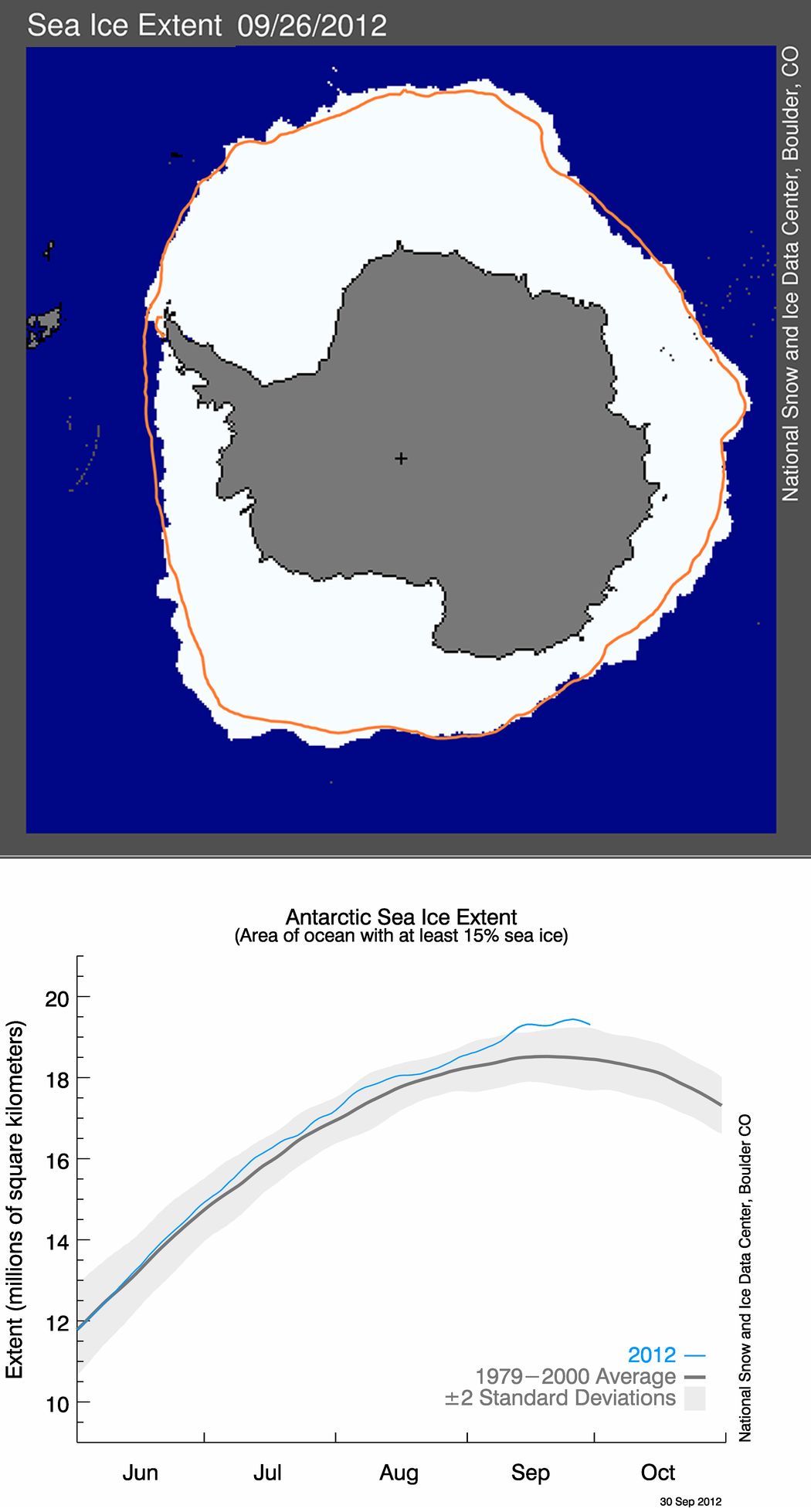
winter sea ice extent in Antarctica has reached a record high. The
Antarctic extent increase is an interesting response to changes in
circulation patterns in the Southern Hemisphere.
A view towards the south
Figure
6a. Antarctic sea ice extent for September 26, 2012 (top image) was
19.44 million square kilometers (7.51 million square miles). The orange
line shows the 1979 to 2000 median extent for that day of the year. The
black cross indicates the geographic South Pole. The graph (bottom)
shows Antarctic sea ice extent as of September 30, 2012. The 1979 to
2000 average is in dark gray. The gray area around this average line
shows the two standard deviation range of the data. Sea Ice Index data.
Credit: National Snow and Ice Data Center
High-resolution image
Credit: National Snow and Ice Data Center
High-resolution image
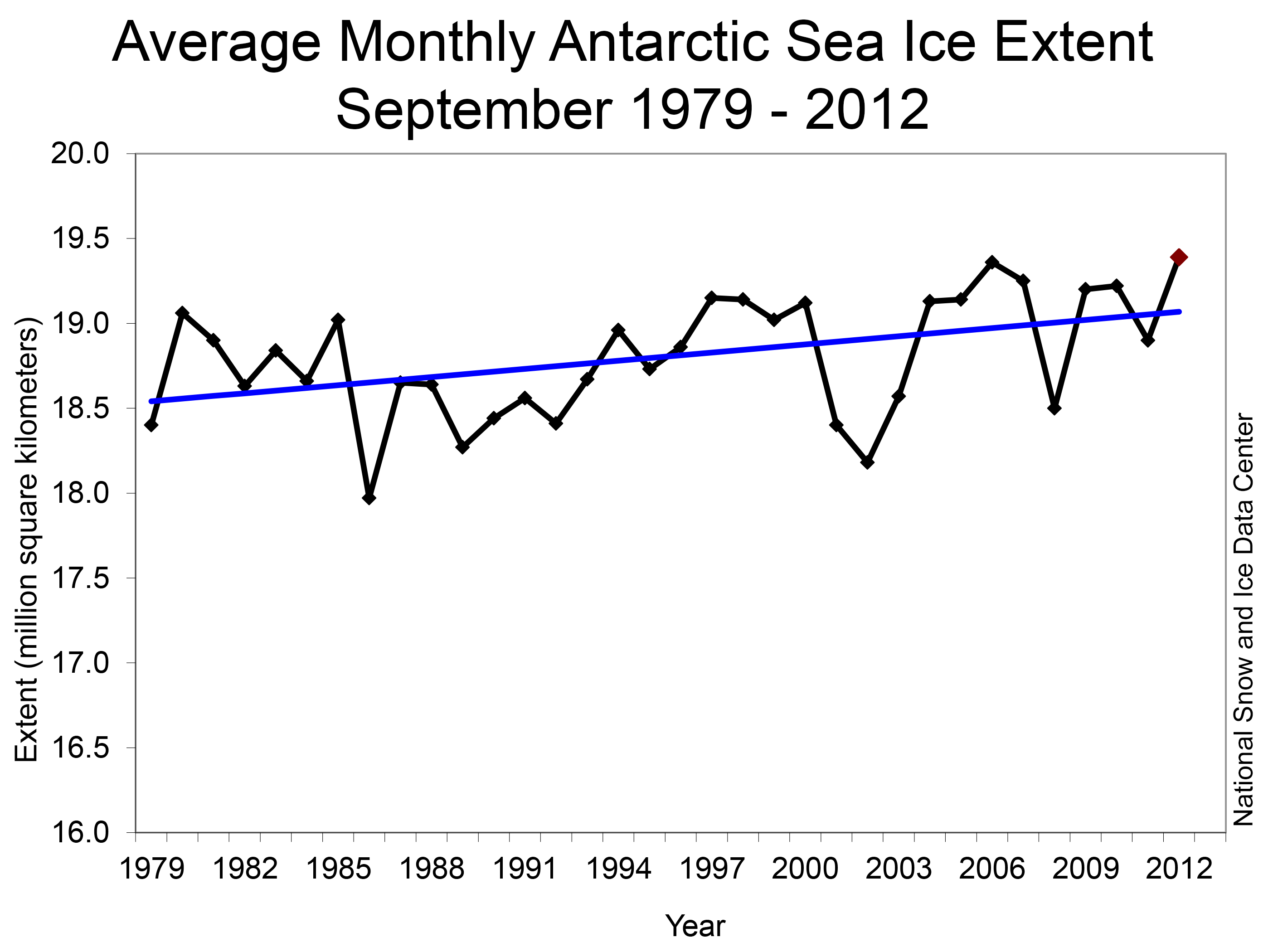
Figure 6b. The monthly September Antarctic extent trend for 1979 to 2012 is +0.9% per decade.
Credit: National Snow and Ice Data Center
High-resolution image
Credit: National Snow and Ice Data Center
High-resolution image
The September extent trend for 1979 to 2012 is just above the statistical significance level (0.9% per decade, plus or minus 0.6%). The new Antarctic sea ice September value is slightly greater than typical year-to-year variations, and is roughly equal to a 25 mile (40 kilometer) northward shift in the location of the ice edge relative to the 1979 to 2000 average. The trend for ice extent growth during Antarctic winters is about 16,000 square kilometers per year (6,200 square miles) or roughly an area the size of Connecticut. In comparison, the decline in Arctic summer sea ice extent is an area about the size of Indiana (91,600 square kilometers per year, or about 35,400 square miles).
Our colleague, Dr. Sharon Stammerjohn of INSTAAR, University of Colorado, provides a review of the differences between Arctic and Antarctic climate controls on sea ice and helps place the events in context. First, climate is warming over much of the Antarctic continent, as shown in several recent studies (e.g., Chapman and Walsh, 2007, Monaghan et al., 2008, Steig et al., 2009) and is related to Pacific Ocean warming (Ding et al., 2010) and circumpolar winds. Both warming and ozone loss act to strengthen the circumpolar winds in the south. This is due primarily to persistently cold conditions prevailing on Antarctica year-round, and a cold stratosphere above Antarctica due to the ozone hole. Stronger winds generally act to blow the sea ice outward, slightly increasing the extent, except in the Antarctic Peninsula region, where due to geography, winds from the north have also increased, pushing the ice southward. Thus, sea ice extent near the northwestern Antarctic Peninsula continues to decline rapidly, while areas in the Ross Sea and the southern Indian Ocean show significant increases (Stammerjohn et al., 2012). Circumpolar-averaged sea ice extent changes nearly cancel each other out for all months of the year (Parkinson and Cavalieri, 2012). This winter, atmospheric conditions were near average overall, with roughly equal areas of cooler and warmer air temperatures over the sea ice.
Comparing winter and summer sea ice trends for the two poles is problematic since different processes are in effect. During summer, surface melt and ice-albedo feedbacks are in effect; winter processes include snowfall on the sea ice, and wind. Small changes in winter extent may be a more mixed signal than the loss of summer sea ice extent. An expansion of winter Antarctic ice could be due to cooling, winds, or snowfall, whereas Arctic summer sea ice decline is more closely linked to decadal climate warming.
For more information on Antarctic climate and sea ice, see NSIDC’s Icelights, our Sea Ice Index, and our State of the Cryosphere Web sites. The NASA Goddard Ozone Watch site also provides additional background information.
Table 1: Previous Arctic sea ice extents for the month of September
| Year | Average Arctic Sea Ice Extent for September | Trend, in % per decade (relative to 1979-2000 avg.) | |
|---|---|---|---|
| in millions of square kilometers | in millions of square miles | ||
| 2007 | 4.30 | 1.66 | -10.2 |
| 2008 | 4.73 | 1.83 | -11.0 |
| 2009 | 5.36 | 2.08 | -11.1 |
| 2010 | 4.90 | 1.90 | -11.5 |
| 2011 | 4.61 | 1.78 | -12.0 |
| 2012 | 3.61 | 1.39 | -13.0 |
| 1979 to 2000 average | 7.04 | 2.72 | |
| 1979 to 2010 average | 6.52 | 2.52 | |
References
Parkinson, C., and D. Cavalieri. 2012. Antarctic sea ice variability and trends. The Cryosphere 6, 871-880, doi:10.5194/tc-6-871-2012.Stammerjohn, S., R. Massom, D. Rind, and D. Martinson. 2012. Regions of rapid sea ice change: an inter-hemispheric seasonal comparison. Geophysical Research Letters 39, L06501, doi:10.1029/2012GL050874.
Ding, Q., E. Steig, D. Battisi, and M. Kuttel. 2011. Winter warming in West Antarctica caused by central tropical Pacific warming. Nature Geoscience 4, doi:10.1038/ngeo1129.
Steig, E., D. P. Schneider, S. D. Rutherford, M. Mann, J. C. Comiso, and D. T. Shindell. 2009. Warming of the Antarctic ice-sheet surface since the 1957 International Geophysical Year. Nature 457, 459-462, doi:10.1038/nature07669.
Monaghan, A. J., D. H. Bromwich, W. Chapman, and J. Comiso. 2008. Recent variability and trends of Antarctic near-surface temperature. Journal of Geophysical Research 113, D04105, doi:10.1029/2007JD009094.
Chapman, W. L., and J. E. Walsh. 2007. A synthesis of Antarctic temperatures. Journal of Climate 20 (16), 4096-4117, doi:10.1175/JCLI4236.1.
Video animations of sea ice extent
Tuesday, 8 May 2012
“Sustainable energy” just isn’t …. well, sustainable

April 25th: At the Vaasa event with Romana Jordan MEP (Slovenia). Very sound on nuclear
But increasingly, engines of this type are also used for power generation, especially as back-up for wind. I’d always assumed that conventional gas-fired generation was the natural back-up for wind, but it seems that these machines are also ideal for the purpose. They can run on heavy or light fuel oil, or natural gas (think shale gas), and on bio-fuels and some oil wastes. They ramp up rapidly as the wind drops, and can switch instantly — literally instantly, we saw it done — from gas to diesel.
Wärtsilä has made a rational commercial decision to market these machines as back-up for wind, given the commitment of European governments to renewables. But the message I took away was that wind, as a significant contributor to power generation, absolutely requires back-up. Otherwise, when the wind drops, the lights go out. We were shown a series of graphs clearly demonstrating the need for additional conventional back-up capacity in the mix, given the typical pattern of wind speeds. (We also saw a graph that destroyed the myth of the Greens, that intermittency can be solved with a European super-grid because “over such a big area, the wind is always blowing somewhere”. No it isn’t. We saw a graph of aggregate wind output over a month in Spain plus Denmark plus Germany, which showed massive variation day-by-day and hour-by-hour, absolutely requiring back-up).
We are hearing in the media that the cost of wind-generated electricity is coming down, and may reach parity with coal and nuclear (although not gas). David Cameron, speaking on April 26th, reaffirmed his faith in renewables and called for prices to come down. “I really believe that renewables can be among our cheapest energy sources in years, not decades”, he said. I mean no disrespect to our Prime Minister, but the level of ignorance and complacency shown by his remarks is truly frightening.
Let’s get back to reality. If you want wind to deliver, say, a megawatt, you need four megawatts of installed capacity (because the load factor is likely to be around 25%). But you also need to build a megawatt of conventional back-up, either Wärtsilä’s internal combustion engines, or conventional gas. You’ve paid the capital cost twice, for the same generating capacity.
But it gets worse. Whichever back-up you use, it will run much less efficiently when it’s substituting variable wind, than if it ran continuously. So its output will cost more, and create higher emissions. A couple of recent reports indicated that the emissions saving of wind plus back-up might be trivial or zero. We’re spending double the money, yet saving little or no CO2. A Wärtsilä presenter put it well, and I wrote down his phrase: because the back-up would be run occasionally, not continuously, its output in relation to capital investment was “not investment feasible”. In other words, you’ve got to pay way over the odds on the output of the back-up, because you’re not just buying electricity — you’re buying insurance against the wind dropping. You’re paying a huge premium for continuity, to prevent black-outs.
Let me offer you an heretical idea: why not just build the back-up, and forget the wind?
Neither government planners nor those who calculate the relative costs of wind and other generating technologies seem to have got a grip on the back-up issue. Estimates of the cost of wind generation make no allowance for double capital requirements, nor for the enhanced costs of intermittent running. And our government, while planning that 30% of our generation by 2020 should come from wind, to meet the EU’s risible emissions targets, seems unaware of the back-up issue.
The best answer you get is that “We have lots of gas, so we can use that for balancing the grid”. But with nuclear power stations phased out with age, and coal-fired power stations being banned by EU regulations, we’ll need all the gas we have just for base-load. We’ll need 30% extra capacity for back-up, otherwise the lights will go out, and we’re not building it. This is a disaster in the making.
The huge costs of capital, and excess production costs from conventional back-up run intermittently, will eventually be passed on to business and domestic consumers. Meantime China and India build cheap coal-fired power stations (no EU regulations there), and America is enjoying a shale-gas bonanza. Energy intensive industries will simply move out of Britain, and out of the EU, to lower-cost areas. Renewables will ensure that the UK economy is no longer economically sustainable. Sustainable energy is not sustainable in economic terms.
Coalition energy policy is a double-whammy. It will destroy the competitiveness of the British economy, while ensuring that black-outs become commonplace by the end of the decade. That’s what the Greens call “Sustainability”.
Saturday, 17 March 2012
The winds of change
 The government has finally seen through the wind-farm scam – but why did it take them so long?
To the nearest whole number, the percentage of the world’s energy
that comes from wind turbines today is: zero. Despite the regressive
subsidy (pushing pensioners into fuel poverty while improving the wine
cellars of grand estates), despite tearing rural communities apart,
killing jobs, despoiling views, erecting pylons, felling forests,
killing bats and eagles, causing industrial accidents, clogging
motorways, polluting lakes in Inner Mongolia with the toxic and
radioactive tailings from refining neodymium, a ton of which is in the
average turbine — despite all this, the total energy generated each day
by wind has yet to reach half a per cent worldwide.
If wind power was going to work, it would have done so by now. The people of Britain see this quite clearly, though politicians are often wilfully deaf. The good news though is that if you look closely, you can see David Cameron’s government coming to its senses about the whole fiasco. The biggest investors in offshore wind — Mitsubishi, Gamesa and Siemens — are starting to worry that the government’s heart is not in wind energy any more. Vestas, which has plans for a factory in Kent, wants reassurance from the Prime Minister that there is the political will to put up turbines before it builds its factory.
This forces a decision from Cameron — will he reassure the turbine magnates that he plans to keep subsidising wind energy, or will he retreat? The political wind has certainly changed direction. George Osborne is dead set against wind farms, because it has become all too clear to him how much they cost. The Chancellor’s team quietly encouraged MPs to sign a letter to No. 10 a few weeks ago saying that ‘in these financially straitened times, we think it is unwise to make consumers pay, through taxpayer subsidy, for inefficient and intermittent energy production that typifies onshore wind turbines’.
Putting the things offshore may avoid objections from the neighbours, but (Chancellor, beware!) it makes even less sense, because it costs you and me — the taxpayers — double. I have it on good authority from a marine engineer that keeping wind turbines upright in the gravel, tides and storms of the North Sea for 25 years is a near hopeless quest, so the repair bill is going to be horrific and the output disappointing. Already the grouting in the foundations of hundreds of turbines off Kent, Denmark and the Dogger Bank has failed, necessitating costly repairs.
In Britain the percentage of total energy that comes from wind is only 0.6 per cent. According to the Renewable Energy Foundation, ‘policies intended to meet the EU Renewables Directive in 2020 will impose extra consumer costs of approximately £15 billion per annum’ or £670 per household. It is difficult to see what value will be got for this money. The total carbon emissions saved by the great wind rush is probably below 1 per cent, because of the need to keep fossil fuels burning as back-up when the wind does not blow. It may even be a negative number.
America is having far better luck. Carbon emissions in the United States fell by 7 per cent in 2009, according to a Harvard study. But the study concluded that this owes less to the recession that year than the falling price of natural gas — caused by the shale gas revolution. (Burning gas emits less than half as much carbon dioxide as coal for the same energy output.) The gas price has fallen even further since, making coal seem increasingly pricey by comparison. All over America, from Utah to West Virginia, coal mines are being closed and coal plants idled or cancelled. (The US Energy Information Administration calculates that every $4 spent on shale purchases the same energy as $25 spent on oil: at this rate, more and more vehicles will switch to gas.)
So even if you accept the most alarming predictions of climate change, those turbines that have ruined your favourite view are doing nothing to help. The shale gas revolution has not only shamed the wind industry by showing how to decarbonise for real, but has blown away its last feeble argument — that diminishing supplies of fossil fuels will cause their prices to rise so high that wind eventually becomes competitive even without a subsidy. Even if oil stays dear, cheap gas is now likely to last many decades.
Though they may not admit it for a while, most ministers have realised that the sums for wind power just don’t add up and never will. The discovery of shale gas near Blackpool has profound implications for the future of British energy supply, which the government has seemed sheepishly reluctant to explore. It has a massive subsidy programme in place for wind farms, which now seem obsolete both as a means of energy production and decarbonisation. It is almost impossible to see what function they serve, other than making a fortune from those who profit from the subsidy scam.
Even in a boom, wind farms would have been unaffordable — with their economic and ecological rationale blown away. In an era of austerity, the policy is doomed, though so many contracts have been signed that the expansion of wind farms may continue, for a while. But the scam has ended. And as we survey the economic and environmental damage, the obvious question is how the delusion was maintained for so long. There has been no mystery about wind’s futility as a source of affordable and abundant electricity — so how did the wind-farm scam fool so many policymakers?
One answer is money. There were too many people with snouts in the trough. Not just the manufacturers, operators and landlords of the wind farms, but financiers: wind-farm venture capital trusts were all the rage a few years ago — guaranteed income streams are what capitalists like best; they even get paid to switch the monsters off on very windy days so as not to overload the grid. Even the military took the money. Wind companies are paying for a new £20 million military radar at Brizlee Wood in Northumberland so as to enable the Ministry of Defence to lift its objection to the 48-turbine Fallago Rig wind farm in Berwickshire.
The big conservation organisations have been disgracefully silent on the subject, like the Royal Society for the Protection of Birds, which until last year took generous contributions from the wind industry through a venture called RSPB Energy. Even journalists: at a time when advertising is in short supply, British newspapers have been crammed full of specious but lucrative ‘debates’ and supplements on renewable energy sponsored by advertising from a cohort of interest groups.
And just as the scam dies, I find I am now part of it. A family trust has signed a deal to receive £8,500 a year from a wind company, which is building a turbine on land that once belonged to my grandfather. He was canny enough not to sell the mineral rights, and the foundations of the turbine disturbs those mineral rights, so the trustees are owed compensation. I will not get the money, because I am not a beneficiary of the trust. Nonetheless, the idea of any part of my family receiving ‘wind-gelt’ is so abhorrent that I have decided to act. The real enemy is not wind farms per se, but groupthink and hysteria which allowed such a flawed idea to progress — with a minimum of intellectual opposition. So I shall be writing a cheque for £8,500, which The Spectator will give as a prize to the best article devoted to rational, fact-based environmental journalism.
It will be called the Matt Ridley prize for environmental heresy. Barring bankruptcy, I shall donate the money as long as the wind-gelt flows — so the quicker Dave cancels the subsidy altogether, the sooner he will have me and the prizewinners off his back.
Entrants are invited forthwith, and a panel of judges will reward the most brilliant and rational argument — that uses reason and evidence — to gore a sacred cow of the environmental movement. There are many to choose from: the idea that wind power is good for the climate, or that biofuels are good for the rain forest, or that organic farming is good for the planet, or that climate change is a bigger extinction threat than invasive species, or that the most sustainable thing we can do is de-industrialise.
My donation, though significant for me, is a drop in the ocean compared with the money that pours into the green movement every hour. Jeremy Grantham, a hedge-fund plutocrat, wrote a cheque for £12 million to the London School of Economics to found an institute named after him, which has since become notorious for its aggressive stance and extreme green statements. Between them, Greenpeace and Worldwide Fund for Nature (WWF) spend nearly a billion a year. WWF spends $68 million a year on ‘public education’ alone. All of this is judged uncontroversial: a matter of education, not propaganda.
•••
By contrast, a storm of protest broke recently over the news that one small conservative think-tank called Heartland was proposing to spend just $200,000 in a year on influencing education against climate alarmism. A day later, the William and Flora Hewlett Foundation, with assets of $7.2 billion, gave a grant of $100 million to something called the ClimateWorks Foundation, a pro-wind power organisation, on top of $481 million it gave to the same recipient in 2008. The deep green Sierra Club recently admitted that it took $26 million from the gas industry to lobby against coal. But money is not the only reason that the entire political establishment came to believe in wind fairies. Psychologists have a term for the wishful thinking by which we accept any means if the end seems virtuous: ‘noble-cause corruption’. The phrase was first used by the Chief Inspector of Constabulary Sir John Woodcock in 1992 to explain miscarriages of justice. ‘It is better that some innocent men remain in jail than the integrity of the English judicial system be impugned,’ said the late Lord Denning, referring to the Birmingham Six.
Politicians are especially susceptible to this condition. In a wish to be seen as modern, they will embrace all manner of fashionable causes. When this sets in — groupthink grips political parties, and the media therefore decide there is no debate — the gravest of errors can take root. The subsidising of useless wind turbines was born of a deep intellectual error, one incubated by failure to challenge conventional wisdom.
It is precisely this consensus-worshipping, heretic-hunting environment where the greatest errors can be made. There are some 3,500 wind turbines in Britain, with hundreds more under construction. It would be a shame for them all to be dismantled. The biggest one should remain, like a crane on an abandoned quay, for future generations to marvel at. They will never be an efficient way to generate power. But there can be no better monument to the folly of mankind.
If wind power was going to work, it would have done so by now. The people of Britain see this quite clearly, though politicians are often wilfully deaf. The good news though is that if you look closely, you can see David Cameron’s government coming to its senses about the whole fiasco. The biggest investors in offshore wind — Mitsubishi, Gamesa and Siemens — are starting to worry that the government’s heart is not in wind energy any more. Vestas, which has plans for a factory in Kent, wants reassurance from the Prime Minister that there is the political will to put up turbines before it builds its factory.
This forces a decision from Cameron — will he reassure the turbine magnates that he plans to keep subsidising wind energy, or will he retreat? The political wind has certainly changed direction. George Osborne is dead set against wind farms, because it has become all too clear to him how much they cost. The Chancellor’s team quietly encouraged MPs to sign a letter to No. 10 a few weeks ago saying that ‘in these financially straitened times, we think it is unwise to make consumers pay, through taxpayer subsidy, for inefficient and intermittent energy production that typifies onshore wind turbines’.
Putting the things offshore may avoid objections from the neighbours, but (Chancellor, beware!) it makes even less sense, because it costs you and me — the taxpayers — double. I have it on good authority from a marine engineer that keeping wind turbines upright in the gravel, tides and storms of the North Sea for 25 years is a near hopeless quest, so the repair bill is going to be horrific and the output disappointing. Already the grouting in the foundations of hundreds of turbines off Kent, Denmark and the Dogger Bank has failed, necessitating costly repairs.
In Britain the percentage of total energy that comes from wind is only 0.6 per cent. According to the Renewable Energy Foundation, ‘policies intended to meet the EU Renewables Directive in 2020 will impose extra consumer costs of approximately £15 billion per annum’ or £670 per household. It is difficult to see what value will be got for this money. The total carbon emissions saved by the great wind rush is probably below 1 per cent, because of the need to keep fossil fuels burning as back-up when the wind does not blow. It may even be a negative number.
America is having far better luck. Carbon emissions in the United States fell by 7 per cent in 2009, according to a Harvard study. But the study concluded that this owes less to the recession that year than the falling price of natural gas — caused by the shale gas revolution. (Burning gas emits less than half as much carbon dioxide as coal for the same energy output.) The gas price has fallen even further since, making coal seem increasingly pricey by comparison. All over America, from Utah to West Virginia, coal mines are being closed and coal plants idled or cancelled. (The US Energy Information Administration calculates that every $4 spent on shale purchases the same energy as $25 spent on oil: at this rate, more and more vehicles will switch to gas.)
So even if you accept the most alarming predictions of climate change, those turbines that have ruined your favourite view are doing nothing to help. The shale gas revolution has not only shamed the wind industry by showing how to decarbonise for real, but has blown away its last feeble argument — that diminishing supplies of fossil fuels will cause their prices to rise so high that wind eventually becomes competitive even without a subsidy. Even if oil stays dear, cheap gas is now likely to last many decades.
Though they may not admit it for a while, most ministers have realised that the sums for wind power just don’t add up and never will. The discovery of shale gas near Blackpool has profound implications for the future of British energy supply, which the government has seemed sheepishly reluctant to explore. It has a massive subsidy programme in place for wind farms, which now seem obsolete both as a means of energy production and decarbonisation. It is almost impossible to see what function they serve, other than making a fortune from those who profit from the subsidy scam.
Even in a boom, wind farms would have been unaffordable — with their economic and ecological rationale blown away. In an era of austerity, the policy is doomed, though so many contracts have been signed that the expansion of wind farms may continue, for a while. But the scam has ended. And as we survey the economic and environmental damage, the obvious question is how the delusion was maintained for so long. There has been no mystery about wind’s futility as a source of affordable and abundant electricity — so how did the wind-farm scam fool so many policymakers?
One answer is money. There were too many people with snouts in the trough. Not just the manufacturers, operators and landlords of the wind farms, but financiers: wind-farm venture capital trusts were all the rage a few years ago — guaranteed income streams are what capitalists like best; they even get paid to switch the monsters off on very windy days so as not to overload the grid. Even the military took the money. Wind companies are paying for a new £20 million military radar at Brizlee Wood in Northumberland so as to enable the Ministry of Defence to lift its objection to the 48-turbine Fallago Rig wind farm in Berwickshire.
The big conservation organisations have been disgracefully silent on the subject, like the Royal Society for the Protection of Birds, which until last year took generous contributions from the wind industry through a venture called RSPB Energy. Even journalists: at a time when advertising is in short supply, British newspapers have been crammed full of specious but lucrative ‘debates’ and supplements on renewable energy sponsored by advertising from a cohort of interest groups.
And just as the scam dies, I find I am now part of it. A family trust has signed a deal to receive £8,500 a year from a wind company, which is building a turbine on land that once belonged to my grandfather. He was canny enough not to sell the mineral rights, and the foundations of the turbine disturbs those mineral rights, so the trustees are owed compensation. I will not get the money, because I am not a beneficiary of the trust. Nonetheless, the idea of any part of my family receiving ‘wind-gelt’ is so abhorrent that I have decided to act. The real enemy is not wind farms per se, but groupthink and hysteria which allowed such a flawed idea to progress — with a minimum of intellectual opposition. So I shall be writing a cheque for £8,500, which The Spectator will give as a prize to the best article devoted to rational, fact-based environmental journalism.
It will be called the Matt Ridley prize for environmental heresy. Barring bankruptcy, I shall donate the money as long as the wind-gelt flows — so the quicker Dave cancels the subsidy altogether, the sooner he will have me and the prizewinners off his back.
Entrants are invited forthwith, and a panel of judges will reward the most brilliant and rational argument — that uses reason and evidence — to gore a sacred cow of the environmental movement. There are many to choose from: the idea that wind power is good for the climate, or that biofuels are good for the rain forest, or that organic farming is good for the planet, or that climate change is a bigger extinction threat than invasive species, or that the most sustainable thing we can do is de-industrialise.
My donation, though significant for me, is a drop in the ocean compared with the money that pours into the green movement every hour. Jeremy Grantham, a hedge-fund plutocrat, wrote a cheque for £12 million to the London School of Economics to found an institute named after him, which has since become notorious for its aggressive stance and extreme green statements. Between them, Greenpeace and Worldwide Fund for Nature (WWF) spend nearly a billion a year. WWF spends $68 million a year on ‘public education’ alone. All of this is judged uncontroversial: a matter of education, not propaganda.
•••
By contrast, a storm of protest broke recently over the news that one small conservative think-tank called Heartland was proposing to spend just $200,000 in a year on influencing education against climate alarmism. A day later, the William and Flora Hewlett Foundation, with assets of $7.2 billion, gave a grant of $100 million to something called the ClimateWorks Foundation, a pro-wind power organisation, on top of $481 million it gave to the same recipient in 2008. The deep green Sierra Club recently admitted that it took $26 million from the gas industry to lobby against coal. But money is not the only reason that the entire political establishment came to believe in wind fairies. Psychologists have a term for the wishful thinking by which we accept any means if the end seems virtuous: ‘noble-cause corruption’. The phrase was first used by the Chief Inspector of Constabulary Sir John Woodcock in 1992 to explain miscarriages of justice. ‘It is better that some innocent men remain in jail than the integrity of the English judicial system be impugned,’ said the late Lord Denning, referring to the Birmingham Six.
Politicians are especially susceptible to this condition. In a wish to be seen as modern, they will embrace all manner of fashionable causes. When this sets in — groupthink grips political parties, and the media therefore decide there is no debate — the gravest of errors can take root. The subsidising of useless wind turbines was born of a deep intellectual error, one incubated by failure to challenge conventional wisdom.
It is precisely this consensus-worshipping, heretic-hunting environment where the greatest errors can be made. There are some 3,500 wind turbines in Britain, with hundreds more under construction. It would be a shame for them all to be dismantled. The biggest one should remain, like a crane on an abandoned quay, for future generations to marvel at. They will never be an efficient way to generate power. But there can be no better monument to the folly of mankind.
The Matt Ridley Prize for Environmental Heresy
Saturday, 21 January 2012
Slowly the Penny Drops
|
Sunday, 19 June 2011
Madness on sea:
At last the damage to our coast is being noticed! DAILY MAIL 18/06/2011
Madness on sea: A massive windfarm is being built off one of our most glorious coastlines and threatens an ecological disaster
Last updated at 12:41 AM on 18th June 2011
A typical North Sea summer evening of alternate rain and sun and I am surging across the waves aboard a powerful launch, in the company of five Norwegians.
Three of them are teenage geography students from a high school outside Bergen. They are chaperoned by their teacher Jan; all here to witness their country's latest maritime engineering feat.
In the distance, long lines of yellow stumps emerge from the sea, giving the illusion that the earth really is flat and we are approaching a fence at the end of the world.

Vision of the future: Scroby Sands offshore wind farm in Norfolk, like the one planned for Sheringham Shoal
In the middle of this futuristic seascape sits a leviathan mother ship, the 14,000-tonne heavy crane vessel Oleg Strashnov, her boom raised more than 100 metres over the swell.
Our guide today is Einar Stromsvag, an affable beanpole of an engineer from a fishing town in the fjords of north-western Norway. Einar is the general manager of Scira Offshore Energy, a joint venture company formed by the global energy giants Statoil and Statkraft, both of which are majority-owned by the Norwegian Government.
What we are inspecting this evening is Einar's baby; Scira's £1 billion flagship project. Covering 14 square miles on completion, it will be the world's second-largest offshore windfarm.
Hundreds of men, mostly Scandinavian but also Dutch and Belgian, are working aboard the couple of dozen boats and ships of the windfarm's fleet. Some live on a converted Danish ferry, at anchor a mile from the construction site. It frees up the holiday season accommodation ashore 'and keeps the men out of the pubs there', remarks Einar.
Not everyone in the project has to live so monastically, however. Einar, for example, is living in a cottage in one of the prettiest coastal villages. And the previous night I had stayed in a nearby hotel, in which the rest of the windfarm management occupy a whole wing.
A member of staff told me that the hotel, the largest in this popular holiday town, is sometimes more than half full of Norse maritime engineers. Yet we are not off Bergen, Stavanger or Tromso. Nor even Northern Scotland. This is the Sheringham Shoal, and some 10 miles to the south, the coast of North Norfolk — granted heritage status — can be seen quite clearly.

Outstanding natural beauty: Sunrise on a misty morning at Holkham Bay on the North Norfolk Coast
And for the moment it remains a precious environment; its many nature reserves are home to rare migrational sea birds and seals, as well as myriad flora along the sand dunes, pine woods and salt marshes.
But now, where the sea meets the sky there is no longer the seamless grey of old. Gargantuan machines are driving piles 30 metres into the seabed as 90 towers rise just below the horizon, as seen from the shore.
The turbines atop them — the first is due to be installed this week and will measure 130 metres high from the sea surface to the tip of one of its three 52-metre blades — will supposedly power our toasters, washing machines and other gadgets for decades to come.
Scira says the farm will power the equivalent of 220,000 average households and save almost 500,000 tonnes of CO2 emissions annually. The first power will be produced later this summer, running through some 40 km of offshore and onshore cable to a sub-station in rural Norfolk. From there, it will enter the National Grid.
It will form part of the Coalition Government's forceful championing of renewable energy — David Cameron has committed the UK to producing 20 per cent of our energy from renewable resources by 2020. The electricity companies are obliged by law to work towards this goal — only we do not appear to have the technological know-how to do it for ourselves.
So the gusts that blow with such vigour off the Norfolk coast are now being harnessed by Norwegians, using German, Dutch and Danish machinery, then sold on to French electricity distribution giant EDF before finally being bought by the British consumer — at considerable mark-up, of course.
Scira has the lease on the seabed beneath or around here for the next 50 years and is looking to build an even bigger turbine field some miles to the north of Sheringham, along the Dogger Bank. The size of North Yorkshire, if approved, it is said. Several other companies or conglomerates are vying to build more windfarms round here. The Crown Estate, which owns the seabed off the UK coast, is considering leases for fields which would dwarf the one at Sheringham Shoal.

New Viking invasion: Villages in Norfolk - Cley Next the Sea, Blakeney and Holt are particularly pretty and popular
The journey to the heart of New Klondike takes you from the seaside town of Sheringham, with its famous steam railway and 'afternoon tea dances', along one of the most exquisite coastal roads in England.
You pass by the picturesque but obsolete wooden windmill at Weybourne, below which the windfarm cable comes ashore, through Stiffkey on the creek-ridden salt marshes and into the town of Wells-next-the-Sea. Horatio Nelson's birthplace, the village of Burnham Thorpe, is a few miles beyond.
In my childhood, Wells was the charming, if ever-so-slightly-shabby, town in a genteel coast dotted with flint cottages and stately homes. Wells lifeboat station sits at the end of the narrow channel which winds through sand bars from the open sea to the town's small inner harbour. I remember during my childhood trudging past it lugging windbreakers for family picnics on the beach.
Recently the landscape has been radically altered. Scira has dredged a new 'Outer Harbour' by the lifeboat station. Its fleet of 12 staff transfer vessels, supply and survey boats are moored alongside new pontoons.
The centre of operations for this activity is to be found in a former school house in the centre of Wells.
On a large electronic wall screen in the control room, 29 vessels and 535 Scira workers are being plotted by a Viking-haired man called Bjorn.
His computer mouse flicks on to a shape that represents one Scira boat. Immediately it shows there are three people on board. Another click gives their names, blood groups, next of kin etc. Very impressive.
Bjorn is a maritime engineer. He would like to drive 'a bloody great dredger' through the notorious sandbar at the end of Wells harbour, but that wouldn't be very popular — Scira is careful to keep in with the locals.
Hundreds of thousands of pounds is being thrown at various community projects along the Heritage Coast; the latest tranche of largesse is some £7,000 to be divided among a community centre in the pretty Georgian town of Holt, near to which the onshore cable trench is being dug, a nursery in Sheringham and a National Coastwatch Station at Mundesley.
Forty local jobs will also, eventually, be created by the Norwegian project. But much of the work is being done elsewhere.
The German engineering giant Siemens not only built the turbines, blades and towers at its facilities in Denmark, but also has the contract for their maintenance. The offshore cables are Norwegian manufactured. The piles for the towers come from Germany, Holland and Belgium. At least the two 1,000-tonne offshore substations were manufactured in Hartlepool.
What we do have to offer in Britain, as an island in the North Atlantic, is a lot of wind and sea.
Scira says the UK coastal waters have around 40 per cent of Europe's entire wind resources. Indeed, we apparently possess the largest shallow-water offshore wind resource in the world. The seabed is easy to drill off Norfolk. The waters are so shallow that even even 10 miles offshore the water is only 20 metres deep.
'If you went that far off Stavanger in Norway, you would find yourself at a depth of 300 metres,' says Einar. 'Then you would be looking at much more complex platforms like oil rigs and not monopiles that we can use here. It would be just too expensive.'
In other words, the windfarms are springing up close to the nature reserves of the east coast because it is the cheapest place to put them.
The higher cost of wind-power electricity compared to that from conventional energy sources is one of the main reservations of those who oppose the New Klondike.

Ecological risks: Seals at Blakeney Point nature
reserve on the North Norfolk coast. Some have washed ashore dead since
work on the windfarm started
In the study of his home, a few miles from where the cables come ashore at Weybourne Hope, he puts it more bluntly: 'The economics don't make sense.' Yet the biggest fear along the coast is the effect the wind turbines' construction and operation will have on its delicate ecosystem.
Scira is treading very carefully. Under the terms of its lease, it is obliged to monitor marine and bird life around the shoal. While many conservation groups support renewable energy, it is a different matter when it is placed in areas like this.
The Royal Society for the Protection of Birds initially objected to Sheringham Shoal, claiming that it would have a devastating effect on the internationally important nesting colonies at nearby Blakeney Point and Scolt Head. It withdrew its opposition having received assurances from Scira, but is now facing a proliferation of windfarms nearby.
Toby Gethin, an RSPB casework officer, said: 'We support renewable energy and windfarms. However, they must not be sited in areas where they have an adverse impact on threatened species.
'We support renewable energy and
windfarms. However, they must not be sited in areas where they have an
adverse impact on threatened species'
'We have outstanding objections and
concerns regarding four further offshore windfarm proposals planned for
the Greater Wash because cumulatively they could result in an adverse
impact on wildlife.'
RSPB casework officer Toby Gethin
Seals have been found dead, perhaps killed by construction boats but no one knows.
Local fishermen, who worked the Sheringham Shoal and are paid 'disruption compensation' during construction, are similarly wary. The National Federation of Fishermen's Organisations said: 'We have not got much choice but to live with the fact the Government has decided to issue licences to build such windfarms and instead try to focus on mitigating the impact of them.
'Only time will tell and that is very worrying.'
Who really knows? Norwegians like Einar can offer experience in oil and gas. But they are windfarm pioneers. They cannot say what impact their turbines will have on the ecosystem, or indeed on our power supplies.
Only this week, it was revealed that windfarms may have to be shut down for 38 days of the year when it gets too windy, because the National Grid cannot cope with a surge in power. And if the wind drops too far, they do not work at all.
But why should the Norwegians who are building the Sheringham Shoal windfarm care about that? Or indeed French giant EDF that will sell the electricity it produces? After all, they're not the ones who live here.
Saturday, 7 May 2011
The Answer Isn't Blowing in the Wind
Because of its enthusiasm to sign up to poorly thought out climate change policies Britain is now on course to have the most expensive electricity in the developed world. By 2020 one third of our electricity bills will be made up of green tariffs, (money taken from us and given almost entirely to wind farm constructors). Industry and commerce will pay an even higher price.
These costs, as you may have noticed from your recent electricity bills, have already begun. Between 2002 and 2010 the UK electricity consumer paid a premium of £5bn over and above the wholesale price of electricity, almost all of that went to wind farm developers. According to calculations made by the Renewable Energy Foundation the subsidy will grow to a still increasing 6bn by 2020 if the policies we have at the moment are not changed. Most of this will go to offshore and on-shore wind energy companies.
A wind farm enthusiast recently told me that we have no right to inflict the legacy of nuclear waste on our grandchildren, but I guess its OK to bankrupt them and sabotage their economic competitiveness.
The REF calculate that, from 2002 to 2020 the scheme will cost around £35bn and that even if these policies were cancelled in 2020, the legal obligation for continued support for the wind farms already built would add a further £65bn in the following decade. All of that will be taken from us.
These costs are not obvious like VAT or income tax because the are hidden in our electricity bills, these charges are levied on private households regardless of income which suggests to me that they will present a disproportionately large burden for the less well off in our society. It also of course adds hugely to the cost of everything else that is manufactured or transported.
These costs were imposed on us by the last government in its eagerness to conform to the EU’s Renewable Electricity Directive, which was to obtain 10% of electricity from renewable sources by 2010. Despite the £5bn subsidy we have significantly failed to do this, managing just 6.5% in 2010, which suggests that the 2020 targets are wildly optimistic.
Wind farm developers and their supporters continually blame what they call ‘Nimbys’ for creating delays through the planning system, but when you are operating in a world that is insulated from the normal constraints of finance and competition I guess democracy might also seem like something you can circumvent; there is however, much more to it than that. With such vast quantities of easy money available to throw at these schemes and the eagerness of these people to get their hands on as much of it as possible, they are not being thoroughly thought through. Take Sheringham Shoal for example, at the beginning of 2010 after the initial explorations were complete they arrived to begin construction with the Svanen, a floating crane used to construct the Øresund bridge that links Sweden to Copenhagen.
Apart from possibly being the main culprit in the deaths of many grey and common seals it was also the wrong piece of equipment for the job, as it was only able to operate in seas with a wave height of a 1mtr or less. Which meant that it spent considerably more time in Yarmouth then it did off Sheringham killing seals. I guess it’s an ill wind that blows no good at all.
Decades of oil exploration in the North Sea mean that more research has been carried out here in respect of wave height and wave/tide effect than on any other body of water on earth, yet still they got it wrong. The upshot of this was that they had to cease operations last autumn, take the Svanen away and begin construction of a completely new lift platform in Norway to complete the job. As yet this hasn't appeared and another larger floating crane has arrived on site. Look out for more seal carcasses.
Grid connection problems also cause wind farm delays as I guess does the reluctance of bankers to invest money in schemes that are only sustainable through subsidy. Low wind conditions, particularly through the very cold weather periods we have had during recent winters also contributed to their failing to achieve the required 10% reductions.
Work done by the Renewable Energy Foundation shows that the 2010 targets would have been missed even if wind speeds had exceeded the highest annual average over the last ten years. The optimism that thought them attainable in the first place seems to be pretty much of the kind we get with most wind farm generation predictions.
Wind farm propagandists make much of the job creation that comes with wind farm development; apparently the wind farms off north Norfolk have so far created 65 new jobs. However, an EU Commission paper released in 2009 showed that the wider economic effects of these targets entailed net job losses for the UK. Not difficult to understand, when all the wind farms are completed off the north Norfolk coast I believe the job losses in the tourism industry here will far outweigh anything that wind farms might temporarily create.
I have not invented this scenario, the facts are out there, they are neither difficult to find or to understand, yet their significance is completely lost (the REF excepted) on the Green lobby and wind energy supporters. Such facts are obviously unpalatable to the government, who cannot be seen to be making U turns. Somehow the truth of all this must become more widely known. I believe that there is an increasing resistance to wind energy as a solution to reducing our reliance on finite resources, but I seriously doubt it will gain enough momentum to so slow this money-making gravy train unless there is a sudden and dramatic sea change in public opinion..
Our future like our landscape is being sacrificed. I sometimes think that the greater the value of what is being sacrificed the more heroic these fanatics believe they are!
Godfrey Sayers 07/05/2011
Thursday, 5 May 2011
Not the Only ones
Scira Offshore Energy Limited have been set back many months as a consequence of selecting the wrong equipment for the construction of Sheringham Shoal wind farm, what their losses are is anybody's guess. It would seem however, that they are not the only ones to catch a cold in this mad rush for easy money.
Fluor
Learns costly EPC lessons
from Greater Gabbard
Long delays and heavy cost
overruns at the 504MW Greater Gabbard offshore wind project have taught an
“expensive lesson” to engineering, procurement and construction (EPC) giant
Fluor, and developers Scottish and Southern Energy (SSE) and RWE Npower
Renewables.
US engineering
giant Fluor Corporation says third quarter results will take a hit of $163m, or
$0.90 a share, because of estimated cost increases on the Greater Gabbard
Offshore Wind Project in the UK.
In a statement,
Fluor says its full-year earnings will now be between $2.20 and $2.50 a share,
versus an earlier estimate of $2.90 to $3.20 a share. It expects to release Q3
results by 4 November.
“During the
third quarter, the project experienced a variety of execution challenges,
including material and equipment delivery issues, primarily relating to the
installation of wind turbine generators and subsea cabling,” the company says
in a statement.
Fluor says it revised estimates to include
substantial costs for additional marine vessels and other subcontractor costs
associated with equipment installation, equipment repairs and the estimated
schedule impact which has been exacerbated by weather-related delays.
“The company
has taken a number of remedial actions to mitigate further cost escalation and
delays to the schedule,” it adds.
Fluor is the
main contractor for the 504MW Greater Gabbard scheme located 23km off the
Suffolk coast. Developer Scottish and Southern Energy is the
developer in the 50-50 joint venture with RWE.
In 2008, Fluor
was awarded a $1.8bn fixed price contract to construct the wind farm. To date,
all 140 monopiles and tower transition pieces have been installed and 53 of 140
wind turbine generators are in place.
Installation
and commissioning of the remaining wind turbine generators, subsea inter-array
cabling and grid substations are expected to continue through the latter part
of 2011. The overall project is expected to be completed in early 2012,
according to Fluor.
The project has
experienced a number of challenges since construction began in late 2008.
Through the second quarter of 2010, the company had recorded $202m in claim
revenue relating to costs incurred on a dispute with the joint venture
regarding specifications for monopiles and transition pieces required under the
contract, says Fluor.
Additional
costs arising from this dispute are expected to be incurred in future quarters.
Fluor continues to pursue claims for costs recoverable under the contract, it
says.
Richard A. Kessler (richard.kessler@rechargenews.com)
Godfrey Sayers 05/05/2011
Godfrey Sayers 05/05/2011
Thursday, 3 February 2011
BBC Bias

http://www.msnbc.msn.com/id/41365053/ns/weather/
The BBC is supposed give us unbiased and accurate news, thats what we pay them to do. Instead all we get for our money is sensationalism and propaganda!
This picture shows the Northern Hemisphere as it is at the moment. Click to enlarge


Thursday, 16 December 2010
The Stitch Up
An investigative journalist with a reputation for uncovering and disseminating the truths and deceits that lie behind western governance has had the good fortune to be handed, what can only be described as a scoop. As any good journalist would he has put it into the public arena, in this case with the collusion of the Guardian, Der Spiegel and The New York Times. While it is questionable whether or not his source Mr. Manning has committed a crime it is fairly clear that he has not.
Had these revelations been about the inner workings of the new coalition and had been leaked to the opposition, they would, as all political parties do, have pounced on them with glee? There are undoubtedly quite legitimate questions as to where the line should be drawn in respect of national security but Mr. Julian Assange, be he the hero or the villain of this piece is being made to pay a heavy price for thinking that Western countries really mean it when they claim that they are committed to press freedom.
All he has done is publish information that the United States of America does not like. Yet we are constantly led to believe that the US is the embodiment of all the fundamental human rights in the UN Charter, including freedom of the press.
Any reasonable person must think that the coincidence of the rape charges and the leaks is suspicious; entrapment is used by many governments to control or smear those they don’t like or want to discredit. Both of the women who Assange is alleged to have raped, publically rejoiced in their relationships with him after the alleged rapes occurred but have subsequently tried to remove those statements from the internet, why?
Both encounters began with their consent and both women claimed that only included the use of condoms because they were worried about the possibility of sexually transmitted disease. Therefore, if they have not been infected and I am sure they will have checked, then they do not have much of a case to bring. Although a high enough financial inducement might persuade them that a small dose of the clap could be a good investment.
It might also occur to some that there is a high probability that intelligence officers (Swedish perhaps, in conjunction with the CIA) might have identified and perhaps approached these women after their encounters and before they made the complaints against Assange.
That the US could do all this is underlined by statements made by some of their leading political figures, Sarah Palin, has called for Mr. Assange to “be hunted down like al-Qaeda and Taliban leaders”. US Senator Joseph I. Lieberman has called for him to be arrested for treason. Bill O'Reilly, a US political commentator has called for him to be executed. When last week, Mr. Assange was arrested in London to face extradition charges, the US Secretary of Defence, Mr. Robert Gates, called it “good news”.
None of us are likely to be much concerned by anything Sarah Palin says, because its for sure she wouldn’t be able to find Julian Assange if he were painted fluorescent pink and blown up to ten times his size, he’s outside Alaska, after all. Mr. Gates however, is another matter, as he is one of the US’s two top defence officials.
What really concerns me however, is how blatantly obvious all of this is, anyone with an IQ above 26 can see what the US are doing and even while they themselves are clearly aware that this is the case they are not being deterred. Up until now most western democracies have, when acting underhandedly, made strenuous efforts to cover their tracks, that the US are not doing so now I find very frightening, its as if they know that the illusion of clean governance is shattered but also realise that it doesn’t matter because there is nothing any of us (except perhaps Julian Assange) can do about it.
Just imagine if anything remotely similar had happened in Iran or China, or Zimbabwe: the US and Europe would have awarded the leaker the Nobel Prize. Just last week, the nations who are chasing Mr. Assange were awarding the Nobel Price to the Chinese dissident Liu Xiaobo, who has been imprisoned in China for inciting subversion. Only when it comes to nuclear weapons are double standards and hypocrisy as blatant as this.
Every nation that subscribes to justice and open democracy will inevitably be judged on their own track record, the USA’s suffered quite a knock with Guantanamo Bay, but this has the potential to be very much worse.
It seems very simple to me (although I have to admit that my IQ is only 38) either we support human rights or we don't; there is no middle way! Such double standards should not go un-challenged.
Godfrey Sayers 16/12/2010
.
Had these revelations been about the inner workings of the new coalition and had been leaked to the opposition, they would, as all political parties do, have pounced on them with glee? There are undoubtedly quite legitimate questions as to where the line should be drawn in respect of national security but Mr. Julian Assange, be he the hero or the villain of this piece is being made to pay a heavy price for thinking that Western countries really mean it when they claim that they are committed to press freedom.
All he has done is publish information that the United States of America does not like. Yet we are constantly led to believe that the US is the embodiment of all the fundamental human rights in the UN Charter, including freedom of the press.
Any reasonable person must think that the coincidence of the rape charges and the leaks is suspicious; entrapment is used by many governments to control or smear those they don’t like or want to discredit. Both of the women who Assange is alleged to have raped, publically rejoiced in their relationships with him after the alleged rapes occurred but have subsequently tried to remove those statements from the internet, why?
Both encounters began with their consent and both women claimed that only included the use of condoms because they were worried about the possibility of sexually transmitted disease. Therefore, if they have not been infected and I am sure they will have checked, then they do not have much of a case to bring. Although a high enough financial inducement might persuade them that a small dose of the clap could be a good investment.
It might also occur to some that there is a high probability that intelligence officers (Swedish perhaps, in conjunction with the CIA) might have identified and perhaps approached these women after their encounters and before they made the complaints against Assange.
That the US could do all this is underlined by statements made by some of their leading political figures, Sarah Palin, has called for Mr. Assange to “be hunted down like al-Qaeda and Taliban leaders”. US Senator Joseph I. Lieberman has called for him to be arrested for treason. Bill O'Reilly, a US political commentator has called for him to be executed. When last week, Mr. Assange was arrested in London to face extradition charges, the US Secretary of Defence, Mr. Robert Gates, called it “good news”.
None of us are likely to be much concerned by anything Sarah Palin says, because its for sure she wouldn’t be able to find Julian Assange if he were painted fluorescent pink and blown up to ten times his size, he’s outside Alaska, after all. Mr. Gates however, is another matter, as he is one of the US’s two top defence officials.
What really concerns me however, is how blatantly obvious all of this is, anyone with an IQ above 26 can see what the US are doing and even while they themselves are clearly aware that this is the case they are not being deterred. Up until now most western democracies have, when acting underhandedly, made strenuous efforts to cover their tracks, that the US are not doing so now I find very frightening, its as if they know that the illusion of clean governance is shattered but also realise that it doesn’t matter because there is nothing any of us (except perhaps Julian Assange) can do about it.
Just imagine if anything remotely similar had happened in Iran or China, or Zimbabwe: the US and Europe would have awarded the leaker the Nobel Prize. Just last week, the nations who are chasing Mr. Assange were awarding the Nobel Price to the Chinese dissident Liu Xiaobo, who has been imprisoned in China for inciting subversion. Only when it comes to nuclear weapons are double standards and hypocrisy as blatant as this.
Every nation that subscribes to justice and open democracy will inevitably be judged on their own track record, the USA’s suffered quite a knock with Guantanamo Bay, but this has the potential to be very much worse.
It seems very simple to me (although I have to admit that my IQ is only 38) either we support human rights or we don't; there is no middle way! Such double standards should not go un-challenged.
Godfrey Sayers 16/12/2010
.
Thursday, 9 December 2010
WikiLeaks Intimidation

The chilling intimidation campaign against WikiLeaks (when they have broken no laws) is an attack on freedom of the press and democracy. We urgently need a massive public outcry to stop the crackdown -- let's get to 1 million voices and take out full page ads in US newspapers this week!
The massive campaign of intimidation against WikiLeaks is sending a chill through free press advocates everywhere.
Legal experts say WikiLeaks has likely broken no laws. Yet top US politicians have called it a terrorist group and commentators have urged assassination of its staff. The organization has come under massive government and corporate attack, but WikiLeaks is only publishing information provided by a whistleblower. And it has partnered with the world's leading newspapers (NYT, Guardian, Spiegel etc) to carefully vet the information it publishes.
The massive extra-judicial intimidation of WikiLeaks is an attack on democracy. We urgently need a public outcry for freedom of the press and expression. Sign the petition to stop the crackdown and forward this email to everyone -- let's get to 1 million voices and take out full page ads in US newspapers this week!
To access these URL s copy and paste into your browser.
http://www.avaaz.org/en/wikileaks_petition/?vl
WikiLeaks isn't acting alone -- it's partnered with the top newspapers in the world (New York Times, The Guardian, Der Spiegel, etc) to carefully review 250,000 US diplomatic cables and remove any information that it is irresponsible to publish. Only 800 cables have been published so far. Past WikiLeaks publications have exposed government-backed torture, the murder of innocent civilians in Iraq and Afghanistan, and corporate corruption.
The US government is currently pursuing all legal avenues to stop WikiLeaks from publishing more cables, but the laws of democracies protect freedom of the press. The US and other governments may not like the laws that protect our freedom of expression, but that's exactly why it's so important that we have them, and why only a democratic process can change them.
Reasonable people can disagree on whether WikiLeaks and the leading newspapers it's partnered with are releasing more information than the public should see. Whether the releases undermine diplomatic confidentiality and whether that's a good thing. Whether WikiLeaks founder Julian Assange has the personal character of a hero or a villain. But none of this justifies a vicious campaign of intimidation to silence a legal media outlet by governments and corporations. Click below to join the call to stop the crackdown:
http://www.avaaz.org/en/wikileaks_petition/?vl
Ever wonder why the media so rarely gives the full story of what happens behind the scenes? This is why - because when they do, governments can be vicious in their response. And when that happens, it's up to the public to stand up for our democratic rights to a free press and freedom of expression. Never has there been a more vital time for us to do so.
SOURCES:
Law experts say WikiLeaks in the clear (ABC)
http://www.abc.net.au/worldtoday/content/2010/s3086781.htm
WikiLeaks are a bunch of terrorists, says leading U.S. congressman (Mail Online)
http://www.dailymail.co.uk/news/article-1333879/WikiLeaks-terrorists-says-leading-US-congressman-Peter-King.html
Cyber guerrillas can help US (Financial Times)
http://www.ft.com/cms/s/0/d3dd7c40-ff15-11df-956b-00144feab49a.html#axzz17QvQ4Ht5
Amazon drops WikiLeaks under political pressure (Yahoo)
http://news.yahoo.com/s/afp/20101201/tc_afp/usdiplomacyinternetwikileakscongressamazon
"WikiLeaks avenged by hacktivists" (PC World):
http://www.pcworld.com/businesscenter/article/212701/operation_payback_wikileaks_avenged_by_hacktivists.html
US Gov shows true control over Internet with WikiLeaks containment (Tippett.org)
http://www.tippett.org/2010/12/us-gov-shows-true-control-over-internet-with-wikileaks-containment/
US embassy cables culprit should be executed, says Mike Huckabee (The Guardian)
http://www.guardian.co.uk/world/2010/dec/01/us-embassy-cables-executed-mike-huckabee
WikiLeaks ditched by MasterCard, Visa. Who's next? (The Christian Science Monitor)
http://www.csmonitor.com/Innovation/Horizons/2010/1207/WikiLeaks-ditched-by-MasterCard-Visa.-Who-s-next
Assange's Interpol Warrant Is for Having Sex Without a Condom (The Slatest)
http://slatest.slate.com/id/2276690/
Subscribe to:
Posts (Atom)